🏛️ Town Board
Clay Town Board Adopts Permit-Fee Law, Advances $30 Million Micron Host Agreement for Fab 1
The Clay Town Board voted 6-0 to adopt a law letting large developers enter voluntary 'Community Host Agreements' in place of standard building permit fees, then held an informational hearing on a proposed three-year, $30 million host agreement with Micron covering the first of its four planned chip fabrication buildings in Clay.
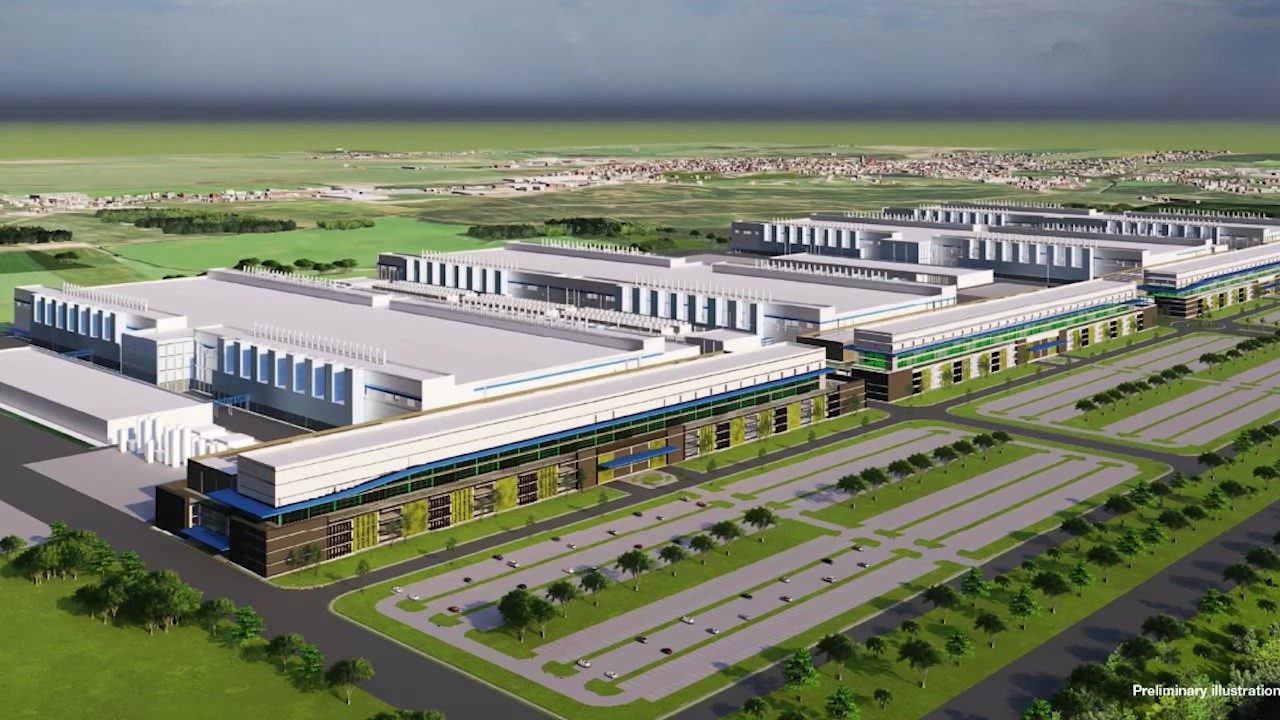
Rendering of Micron's planned fabrication plant at White Pine Commerce Park — photo:
Micron, via Town of Clay
(COURTESY)
The Clay Town Board voted 6-0 on July 7 to adopt a new local law changing how the town charges building permit fees on its largest construction projects, then used the same special meeting to open an informational hearing on a proposed $30 million host agreement with Micron New York Semiconductor Manufacturing, LLC. Deputy Supervisor Joseph Bick chaired the session in the absence of Supervisor Damian Ulatowski.
Local Law No. 7 of 2026, titled the "Large-Scale Development Permit and Community Host Agreement Authorization Law," applies to projects costing $100 million or more. It lets developers of such projects voluntarily enter a Community Host Agreement with the town rather than pay building permit fees under the existing formula — $100 for the first $1,000 of project value and $7 for every $1,000 after that. Bick told residents at the public hearing that the current code, which restricts all fees collected to covering town inspection costs, is prohibitive for development at this scale, and that the new law opens funding options for infrastructure and community projects instead. He said the law takes effect once filed with the New York Secretary of State, and stressed that entering a Host Agreement remains voluntary — a developer who declines would still owe the standard permit fee, which can legally be spent only on inspections.
Immediately after that hearing closed, the board opened an informational hearing on a proposed Community Host Agreement between the town and Micron. According to a presentation Bick gave to the board, the agreement would cover only the first of Micron's four planned chip fabrication buildings in Clay, a project the presentation described as part of a four-factory campus valued at $51 billion. Under the proposed terms, the agreement would run three years, with Micron paying the town $20 million in three annual installments and directing another $10 million in Green Chips Act funding exclusively to Clay, for a combined $30 million. Councilor Ryan Russell told the board the amount to be collected would exceed the town's own budget and called the agreement highly consequential for Clay. Bick called it a "pioneer agreement," saying nothing like it currently exists and that the town had done due diligence to ensure the arrangement benefits both sides.
The minutes contain conflicting numbers for the cost of Fab 1 and the fee it would otherwise generate. During the public-hearing discussion, Bick said the cost for Fab 1 is $89 billion and that permit fees under the standard formula would be $69 million. But the presentation slides on the Micron agreement put Fab 1's construction cost at $8.9 billion, with a $62 million fee under the current code. The minutes do not reconcile the two sets of figures. Separately, the presentation noted that applying the standard fee formula to the entire $51 billion, four-factory project would produce a fee near $273 million, and that the town's initial negotiating position had sought $150 million over 15 years to cover the whole project before the parties settled on the smaller, Fab 1-only deal.
Resident Shelly Hotaling asked how much Micron had offered, citing figures of $15 million for fees and inspections and $6 million for the town — different from the $30 million total described elsewhere in the meeting — and said the agreement should go before voters. Bick said it would not go to a referendum, but that resident input would be part of the process going forward. Resident Evan Nobis asked how the town arrived at the $30 million figure and raised sound barriers and state Department of Environmental Conservation water-mitigation requirements as concerns. A commenter identified as Chuck from Fairways said construction trucks have been using Morgan Road, which he said was not designed for that traffic; Bick said construction vehicles are not supposed to use Morgan Road, asked residents to report trucking company names to Town Hall, and said a planned rail spur would eventually reduce truck traffic. Resident Aaron Schanbacher suggested any infrastructure spending include public sewers for residents not yet connected, low-cost housing, and restrooms at the Meltzer Park playground. Resident Paul Doody asked about forming a citizens advisory board.
After both hearings closed, the board adopted a resolution finding Local Law No. 7 a Type II action under SEQRA requiring no further environmental review, and approved the law 6-0. Bick then moved a separate resolution approving the Community Host Agreement with Micron, seconded by Councilor David Capria; the minutes do not record a specific vote count on that motion before the board moved to adjourn. The meeting closed at 6:17 P.M. on a 6-0 vote.
Coverage of the Town Board meeting on 2026-07-07, Town of Clay, NY. View original document ↗ · Meeting record
Minutes report. Drafted by our AI minutes pipeline from the official minutes — the board's own record of the meeting — and checked against that record by an automated verification gate before publication.
Published under the editorial responsibility of Matthew Broudy, who is accountable for every article on this site. How our pipelines work · Report an inaccuracy · Editorial policy.
🔍
Ask Clay
Have a question about this story? Search across meeting transcripts, town history, and municipal code.
Community Discussion
0 commentsBe the first to comment on this story.