Clay, New York
· Sunday, September 20, 2026· Sep 20, 2026
click for forecast ↓↓
📰 Editorials
Clay's $100 Fee Formula Just Met an $89 Billion Project
Clay's building-permit fee formula - $100 for a project's first $1,000 of value, $7 per thousand after - was built for houses and strip malls; on July 7, 2026, town officials priced Micron's Fab 1 alone at $89 billion and calculated what that old formula would produce: $69 million in fees the state only lets the town spend on inspections. The same collision, of ordinary-scale rules meeting extraordinary-scale machines, runs through the town's whole 2026 record: a battery-storage law repeatedly loosening its own safety numbers while three permit applications wait, a zoning code with no category at all for data centers, and a $30 million Community Host Agreement with Micron that was moved and seconded on July 7 - with no vote recorded before the meeting adjourned.
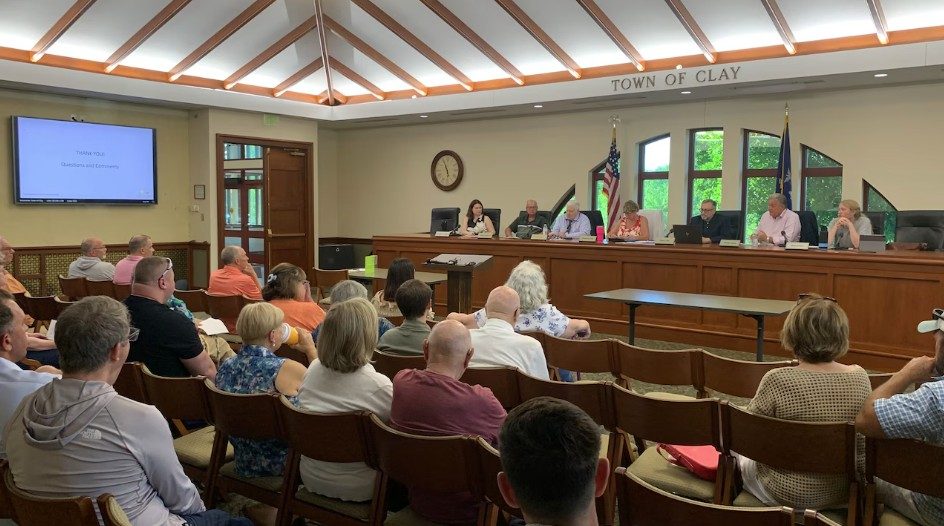
Residents fill the Town of Clay board room for the Micron Community Host Agreement meeting, July 2026 — photo:
Town of Clay
(COURTESY)
▶Key Actions & Decisions
●Jan. 21, 2026 Town Board, 7-0: called Feb. 2 public hearings on three battery energy storage system (BESS) special-permit applications - Nexamp's Wetzel Road Storage and Long Branch Storage projects and Carson Power's Goguen Drive project
●Feb. 2, 2026 Town Board: held the hearings; Nexamp's Olivia Sproviero said the batteries run about 75 decibels and that emergency dispatch, based in Massachusetts 6-8 hours away, could reach Clay in about 4 hours; residents cited the burden on volunteer fire departments and asked for denial or a moratorium; all three cases were referred to the Planning Board
●Feb. 25, 2026 Planning Board: recommended tabling BESS applications until a full ordinance exists; Deputy Chair Mitchell said he was "not in favor of current approval" pending answers on siting, screening and fire-department training
●April 6, 2026 Town Board, 7-0: adopted Local Law No. 3 (f/k/a No. 4), a six-month moratorium on new BESS zoning and special-permit decisions; same night called an April 20 hearing on a permanent Chapter 209 "Battery Energy Storage System Law"
●April 20-June 1, 2026: that law went through repeated revisions - by May 18, what Deputy Supervisor Bick called its "4th revision," required setbacks had been cut from 100 feet to 50, and the emergency-response requirement loosened from 1 hour to 2, even as Nexamp's John O'Hern argued the state fire code only requires 4; by June 1 it was a 5th draft with no further changes, and the hearing - along with the original three BESS applications - was adjourned again, to July 20
●June 1, 2026 Town Board: the same meeting that re-adjourned the still-unfinished BESS law, the board also called a June 15 hearing on Local Law No. 6, a proposed moratorium of up to 12 months on data centers, AI computing facilities and cryptocurrency mining - uses the existing zoning code does not otherwise address
●June 15, 2026 Town Board: held the hearing; Bick said the proposal predated Onondaga County's announcement of funding for a study of such facilities; the IBEW contacted the town to oppose the moratorium while Councilor Young and residents Michele Bristol and Kris Beckett spoke for it; the excerpted minutes record no vote adopting Local Law No. 6, and the next meeting's minutes reference an intervening June 29 special meeting not included in this record
●July 7, 2026 Town Board, 6-0: adopted Local Law No. 7, the "Large-Scale Development Permit and Community Host Agreement Authorization Law," covering projects of $100,000,000 or more; Bick told the hearing Fab 1 alone costs $89 billion against $69 million in old-formula fees, while the town's own presentation that night put Micron's planned four-factory campus at $51 billion
●July 7, 2026 Town Board: a Community Host Agreement with Micron New York Semiconductor Manufacturing, LLC - $20 million over three years plus $10 million in Green Chips spending dedicated to the town, a total Paul Doody's question put at $30 million, which Councilor Russell noted exceeds the town's own budget - was moved by Bick and seconded by Councilor Capria; the minutes record no vote on that motion, only that the meeting adjourned at 6:17 P.M.
Clay charges $100 for the first $1,000 of a building permit's value, and $7 for every $1,000 after that. It is the formula the town has used for additions, garages and strip malls for years, and under state law, the fees it produces can be spent on nothing but inspections. On July 7, 2026, Deputy Supervisor Bick stood before a public hearing and ran that formula against Micron's Fab 1, a project he priced at $89 billion. The answer was $69 million - a sum the town would be legally required to spend on inspections alone, on a project the fee code's ordinary-development math was never built to handle. Bick told the room plainly there was no precedent for fees at this scale.
That collision - an ordinary-scale rulebook meeting machines of an entirely different magnitude - is not confined to one hearing. It runs through everything Clay's Town Board has done in 2026. A battery-storage law has spent six months loosening its own numbers - a setback distance, a response-time requirement - because the versions modeled on ordinary industrial uses did not fit. A zoning code with categories for solar farms and cell towers has no category at all for data centers, artificial intelligence computing or cryptocurrency mining, which is why the board's only tool has been a temporary moratorium rather than a permit process. And the single largest dollar figure in this record, the $30 million Community Host Agreement tied to Micron, was moved and seconded on July 7 - and then, according to the minutes as released, never put to a recorded vote before the meeting adjourned.
The battery-storage law shows the strain most clearly because the board has had to keep rewriting it. On Jan. 21, the Town Board voted 7-0 to call Feb. 2 hearings on three applications: Nexamp's proposed Wetzel Road Storage and Long Branch Storage facilities, using Tesla Megapack batteries tied into the National Grid system, and Carson Power's project on Goguen Drive. At the Feb. 2 hearing, the code's assumptions met an industry the town had never dealt with before: Nexamp's Olivia Sproviero said the units run about 75 decibels, and that the company's emergency dispatch team is based in Massachusetts, 6 to 8 hours away, though she said it could reach Clay in about 4. Residents pressed on the burden that would put on volunteer fire departments and asked the board to deny the applications or impose a moratorium. All three were referred to the Planning Board, which by Feb. 25 was recommending the town not act on individual applications until a comprehensive ordinance existed. "I am not in favor of current approval," Deputy Chair Mitchell said, citing unresolved questions about siting, screening and whether volunteer firefighters were trained for this kind of emergency.
The Town Board froze new BESS decisions for six months with Local Law No. 3, adopted 7-0 on April 6, and began drafting a permanent law the same night. That draft kept changing. By May 18 - the fourth revision, in Bick's own count - required setbacks from residential property had been cut from 100 feet to 50, and the mandatory emergency-response time had been loosened from one hour to two. Developers argued even that was too strict: Nexamp's John O'Hern said a two-hour requirement was tighter than the state fire code's own four-hour standard, and attorney Sara Yoon, representing Aurora Renewables, filed repeated letters objecting to the setback and wetlands language. By June 1, Bick reported no changes since a fifth draft had been posted, and the board adjourned the hearing again, to July 20 - taking the three original 2026 applications with it, six months after they were filed.
That same June 1 meeting, without having closed the book on batteries, the board opened an entirely new front: a hearing, set for June 15, on Local Law No. 6, a moratorium of up to 12 months on "large-scale data centers, artificial intelligence ('AI') computing facilities, cryptocurrency mining operations, and similar high-intensity computing uses" - a category the town code had never defined until this law tried to. At the June 15 hearing, Bick said the proposal predated Onondaga County's own announcement of funding for a study of such facilities. The IBEW contacted the town to oppose it; Councilor Young said the scale of electricity involved justified a pause, and residents Michele Bristol and Kris Beckett spoke in favor for the same reason. The minutes as released do not record a vote adopting Local Law No. 6; the following meeting's minutes reference an intervening June 29 special Town Board meeting that is not included in this record.
Micron's own track moved furthest. On July 7, the board adopted Local Law No. 7, the fee-and-host-agreement law, 6-0, creating the $100,000,000 threshold and the voluntary host-agreement option the old fee code had no room for. Resident Paul Doody asked for a breakdown of the resulting Community Host Agreement: $20 million over three years plus $10 million in Green Chips spending dedicated to the town, a total of $30 million that Councilor Russell noted exceeds the town's own budget. Other residents raised construction-truck traffic on Morgan Road, and Aaron Schanbacher suggested the money go toward low-cost housing, restrooms at Meltzer Park and sewer extensions for residents who lack them. Then came the motion, the second - and, in the minutes as released, the adjournment, with no vote recorded in between.
What to watch: the three original 2026 BESS applications and the still-unadopted battery-storage law are due back before the Town Board on July 20, 2026. Whether Local Law No. 6's data-center moratorium was ultimately adopted is not established by the record reviewed here, which points instead to a June 29 special meeting not included in it. And whether the board takes up a recorded vote on the Micron Community Host Agreement remains open in the minutes as released.
Share
Coverage of the Editorials meeting on 2026-08-02,
Town of Clay, NY.
· Meeting record
Minutes report. Drafted by our AI minutes pipeline from the official minutes — the board's own record of the meeting — and checked against that record by an automated verification gate before publication.
●July 7, 2026 Town Board, 6-0: adopted Local Law No. 7, the "Large-Scale Development Permit and Community Host Agreement Authorization Law," defining large-scale development as $100,000,000 or more in project cost and authorizing the town to negotiate voluntary Host Agreements instead of the standard fee formula
●During that hearing, Deputy Supervisor Bick told the board there is no precedent for fees at this scale, citing Fab 1's cost as $89 billion and the resulting permit fee as $69 million — money usable, under existing law, only for inspection costs
●The Host Agreement presentation given later the same night put Fab 1's construction cost at $8.9 billion with a $62 million fee under current code, a tenfold gap from the $89 billion figure cited earlier, with fee estimates that don't scale proportionally between the two
●The presentation's own risk analysis said Micron could sue to recover a fee it was forced to pay in full, and that a judge weighing only the town's actual cost of service — case law behind it, per the slides — could leave the town with far less than the formula implies
●Negotiation history per the presentation: an opening ask based on the $51 billion value of all four planned fabs (a formula fee near $273 million), the town's own initial request of $150 million over 15 years for the full project, before settling on Fab 1 alone for $30 million over three years ($20 million in three annual payments plus $10 million in Green Chips Act spending dedicated to the town)
●Resident Shelly Hotaling gave the board a different tally — $15 million for fees/inspections and $6 million for the town — and argued the agreement should go to a public referendum; Deputy Supervisor Bick said it would not go to a vote of residents
●Councilor Russell said the money involved exceeds the town's own budget; Deputy Supervisor Bick called the arrangement "a pioneer agreement, nothing like this currently exists" and said the town had done its own diligence "to ensure everyone benefits"
●Councilor Russell separately noted the agreement covers only the Fab 1 portion of Micron's larger, multi-fab project
●Immediately after Local Law No. 7 passed, Deputy Supervisor Bick moved adoption of the Community Host Agreement with Micron New York Semiconductor Manufacturing, LLC, seconded by Councilor Capria — the minutes as released record no vote on that motion before the next recorded vote, a 6-0 vote to adjourn at 6:17 p.m.
●Residents floated uses for the money — sewers, roads, parks, splash pads, low-cost housing, Meltzer Park restrooms, sound barriers, a citizens' advisory board — none committed by the law itself, which leaves spending beyond administrative costs "at the town's discretion"
Rezoning Would Multiply a Lawton Road Parcel From 8 Possible Lots to 61
●Town Board opened the public hearing on Case #1251, The Reserve at Clay (RA-100 to R-7.5 rezoning for ~61 lots on 20.18 acres at 8201 Lawton Road), May 18, 2026, then reopened it June 15 after a Planning Board recommendation; no final vote appears in the record.
●Applicant Cornerstone Homes CNY LLC, represented by Tim Coyer of Ianuzi & Romans, proposes demolishing the existing house at 8201 Lawton Road and building 61 lots around a loop road extending Harriet Fisher Drive, connecting to Lawton Road at the site's northeast corner.
●Commissioner of Planning and Development Brian Bender told the Town Board the parcel could yield only 8 to 10 lots if it stayed zoned RA-100, versus the 61 proposed under R-7.5.
●Planning Board recommended the zone change 5-1 on June 10, 2026 (Henty, Guinup, Palumbo, Mitchell and Chairwoman Borton in favor; Graves opposed, saying he would "go with the neighbors" and proposing RA-100 as an alternative) -- after two sessions (May 27 and June 10) in which the Town of Cicero, which shares jurisdiction over Lawton Road, never responded to Clay's outreach for comment.
●Onondaga County Planning Board found no significant adverse implications but recommended county health department/OCWA sign-off on wastewater extensions, walkable connections to the surrounding area, and stormwater facilities kept on their own lots.
●Residents at the May 18 Town Board hearing raised drainage, wildlife (including red-tailed hawks and blue herons) and trash concerns; applicant's representative Tim Coyer said state law bars new development from worsening a neighbor's drainage, and the Deputy Supervisor said there are no wetlands on the property.
●At the May 27 and June 10 Planning Board hearings, residents David Yates (5404 Brisbane Trail) and Nick Gallipeau (3201 Harriet Fisher Drive) objected to the loss of trees and to added traffic on Lawton Road.
●The minutes describe the applicant's traffic study two different ways four weeks apart: "no significant impact" on May 18, versus "there will be impact with this construction" on June 15; resident Chris Underwood told the Town Board the study dates to November 2024 and does not account for Micron-related traffic growth, and raised concerns about speed and unhelmeted e-bike riders on Lawton Road.
On Liverpool's School Board, the Routine Vote Is Always 5-4 — the Real Ones Never Are
●June 8, 2026: all fourteen routine business items (minutes, personnel actions, treasurer's reports, a budget transfer) passed on the identical 5-4 vote — Nicholas Blaney, Kimberly Martin, Daniel McKeever, John Solazzo and Alexandra Gyder voting yes each time; Jecenia Bresett, Stacey Chilbert, Kimberly Melnik and Matthew Jones voting no each time
●June 8: after two speakers addressed workforce reductions and early-retirement incentives during public comment, a motion to table a resolution abolishing an unspecified number of positions failed 3-4-1 (Blaney abstaining); the abolishment resolution itself then carried 6-2, with McKeever and Jones the only dissents
●June 8: the board voted 5-3 to appoint Michelle Merlino to fill the seat left by Kimberly Martin's resignation, effective June 30, 2026
●June 8: the meeting opened at 6:37 p.m. and did not adjourn until 12:34 a.m.
●July 7, 2026: at the annual reorganization meeting, newly elected members Dawn Curry-Clarry and Victoria Baratta and appointed member Michelle Merlino took their seats; Stacey Chilbert and Daniel McKeever no longer appear among members present; the board elected Alexandra Gyder as President and Kimberly Melnik as Vice President, both unanimously
●July 7: a motion to enter executive session later that night failed 3-5-1, with Gyder abstaining
●July 21, 2026: a proposed tax certiorari settlement with Target #1475 in the Town of Clay tied 4-4 and failed
●July 21: the board voted 5-3 to appoint Kimberly Vile as Deputy School Purchasing Agent and 2-5-1 to reject a routing-efficiency study contract with FEH BOCES
Town Board Denies Wegmans Plaza McDonald's After 14 Months of Redesigns — for the Reason Everyone Kept Naming
●January 22, 2025 Town Board: the original McDonald's application for 4979 W. Taft Road (Case #1210, on file since 2024) was declared abandoned and denied after no one appeared for the applicant; it had already been adjourned four times since August 2024
●March 17, 2025 Town Board, 7-0: called a new public hearing on a re-filed application (Case #1224) for a 1.33-acre drive-thru restaurant on the same parcel, two months after the original application (Case #1210) had been declared abandoned
●April 9, 2025 Planning Board: Chairman Mitchell withheld a referral pending a full site drawing of internal traffic circulation; resident Sandy Laurenti told the board 300 petitions had been submitted to the Town Board two days earlier; resident Erika Gallucci told the board McDonald's had been rejected for a one-lane drive-thru at this site in 2016
●Town Board adjourned the Case #1224 public hearing four consecutive months — April 7, May 5, June 2 and July 21, 2025 — before closing it on August 18, 2025
●May 28 and July 9, 2025 Planning Board sessions: the applicant's engineers shifted the building east, cut proposed parking from 64 to 43 spaces and reworked drive-thru islands to route exiting traffic toward the signal at Taft Road, while board members Graves, McMahon and Henty repeatedly said drivers would still cut through to Cedar Post Road
●August 18, 2025 Town Board: the applicant's traffic consultant (GTS) and the town's own consultant (C&S) presented conflicting studies over where exiting traffic would go; the applicant said it would withdraw from the site rather than force the issue if the town and residents did not want it there
●September 3, 2025 Town Board, 6-0: adopted findings citing the town's C&S study — 10 crashes at West Taft Road and Cedar Post Road in three years, eight of them right-angle collisions, and a drop in level of service from "E" to "F" at that intersection and at Bear Road under the McDonald's build scenario — and denied both the special permit and the related zone change
●Councilor Pleskach submitted written comments opposing both applications in advance; the roll-call votes recorded that night list six of the seven board members, without Pleskach among them
A Councilor Predicted a Pattern for Route 31. Eighteen Months and Four Bank Drive-Thrus Later, the Record Backs Him Up.
●Feb. 3, 2025 Town Board, 6-0 (one councilor abstaining): denied Summit Federal Credit Union's zone change for a West Taft Road drive-thru branch, citing residential proximity, an unsignalized intersection and hazardous Wegmans-lot traffic
●March 3, 2025 Town Board, 6-0: approved Seneca Savings' zone change from RA-100 to O-2 for a drive-thru bank on State Route 31
●May 5, 2025 Town Board: Northern Credit Union withdrew its West Taft Road zone-change request for NC-1 commercial zoning after neighborhood opposition and the same night sought a new hearing for O-2 zoning instead; Councilor Pleskach, at that meeting's Seneca Savings hearing, said the O-2 zoning may set a precedence for future development along the Route 31 corridor, according to the minutes
●May 19, 2025 Town Board: approved three drive-thru bank applications in one meeting — Canandaigua National Bank's special permit 4-2, Seneca Savings' special permit 6-0, and Northern Credit Union's revised O-2 zone change 6-0
●Sept. 3, 2025 Town Board, 6-0: denied McDonald's zone change and special permit for a drive-thru on the same stretch, citing "definable specific harm," after the county planning department had required a traffic study covering Northern Credit Union, Summit Credit Union, Inverness Gardens housing and McDonald's together
●Oct. 8, 2025 and Nov. 19, 2025 Planning Board, 6-0 each: approved final site plans for Canandaigua National Bank (after 5 rounds of adjournment) and Seneca Savings (after 8 rounds)
●Nov. 17, 2025 Town Board, 4-0: approved a special permit for a second Northern Credit Union branch at 3584 State Route 31, after an area variance reduced its Route 31 setback to 129 feet
●Dec. 15, 2025 Town Board, 7-0: approved Northern Credit Union's special permit for its West Taft Road branch; its site plan remains under Planning Board review, adjourned a tenth time to Aug. 12, 2026
●Feb. 11-March 16, 2026: Summit Federal Credit Union, denied in 2025, returned with a new application at 4955 West Taft Road after its old location's lease came up for non-renewal; the Planning Board recommended it 7-0 and the Town Board approved the zone change and two special permits unanimously
●May 18, 2026 Town Board, 5-1 (Councilor Gauthier opposed): approved a special permit for Community Bank's new drive-thru branch at 4000 State Route 31, after zoning variances; its site plan remains pending, adjourned to July 22, 2026
The High-Stakes Gamble: How Clay, NY Became the Battleground for the Future of Energy Storage
Community Discussion
0 commentsBe the first to comment on this story.